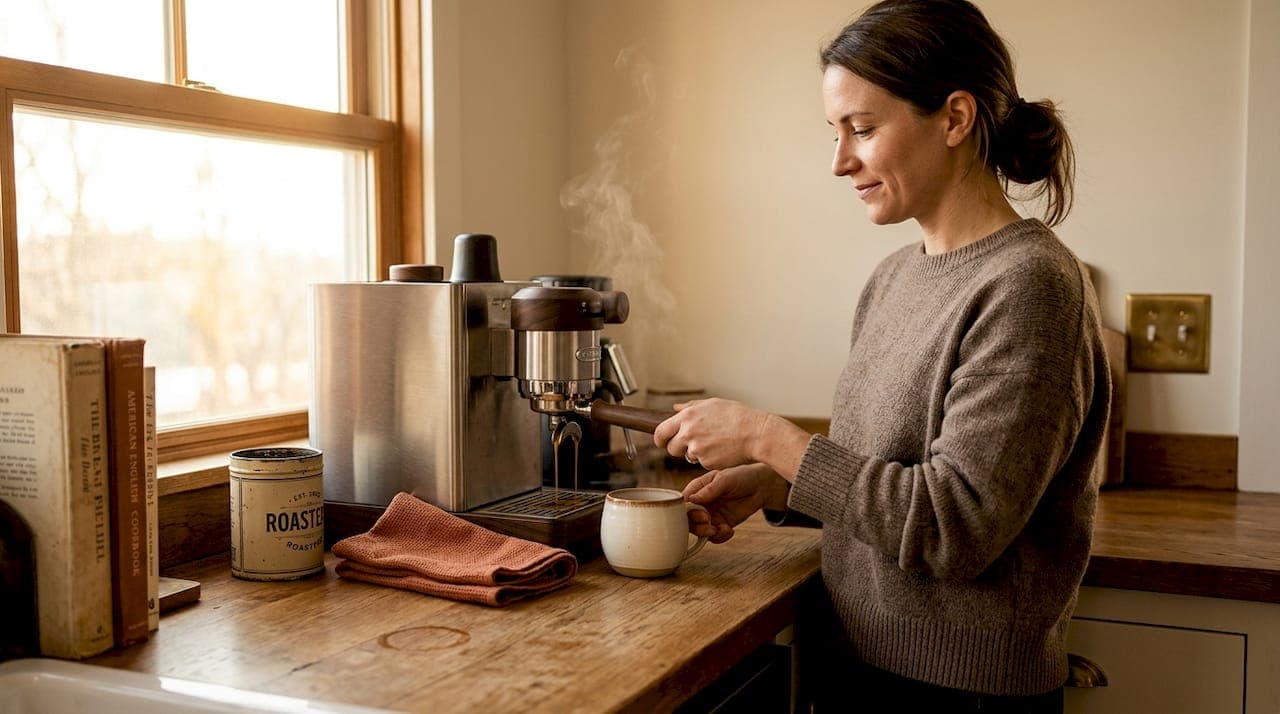
If you've ever measured your counter, ordered a machine, and then discovered it barely fits with the cabinet door open, you already understand why the espresso machine footprint matters. The footprint isn't just the width times the depth printed on the box. It's the total space a machine occupies and demands during real use, including the portafilter sticking out front, the steam wand swinging to the side, and the breathing room required behind and above. Getting this right before you buy saves you from a frustrating rearrangement after the fact.
Table of Contents
- Key takeaways
- What is espresso machine footprint, explained
- Ventilation and clearance: the invisible footprint
- How machine features expand the real footprint
- How to measure your space for an espresso machine
- Footprint and machine selection: matching size to your needs
- My take on footprint planning
- Find the right machine for your space
- FAQ
Key takeaways
| Point | Details |
|---|---|
| Footprint goes beyond specs | Manufacturer dimensions are a starting point, not the full picture of space needed. |
| Portafilter adds real depth | A portafilter in use can add several inches to the front of the machine's effective footprint. |
| Ventilation clearance is non-negotiable | Leave at least 2 to 3 inches on all sides and more above for heat and maintenance access. |
| Steam wand needs room to work | Plan for 6 to 8 inches of clear space on the wand side for pitcher movement. |
| Compact machines still need workflow space | Even the smallest espresso machines require operational clearance beyond their chassis. |
What is espresso machine footprint, explained
The term "footprint" in espresso machine context refers to the total floor area a machine occupies on your counter, plus the surrounding space it needs to function safely and comfortably. Manufacturers publish width, depth, and height figures, and those numbers are your starting point. But they describe only the chassis. The real espresso machine footprint explained properly includes every protrusion, every moving part, and every clearance zone that comes into play the moment you start pulling shots.
Take the Breville Barista Express as a concrete example. Its published espresso machine dimensions are 12.5 inches wide, 13.8 inches deep, and 15.9 inches tall. That sounds manageable on paper. But once you factor in the portafilter locked in position, the steam wand extended for frothing, and the clearance needed behind the machine for the water tank, the actual space commitment grows substantially. Thinking of footprint only as width times depth is one of the most common and costly planning mistakes you can make.
Espresso machine size also has a vertical dimension that many buyers overlook entirely. Cup clearance between the drip tray and the group head determines whether your favorite mug fits under the spout. The Gaggia Classic Pro, for example, offers roughly 8.5 cm of stock cup clearance. That's tight for a tall travel mug. A slim drip tray can recover 1.5 to 2.5 cm, which changes your workflow entirely.
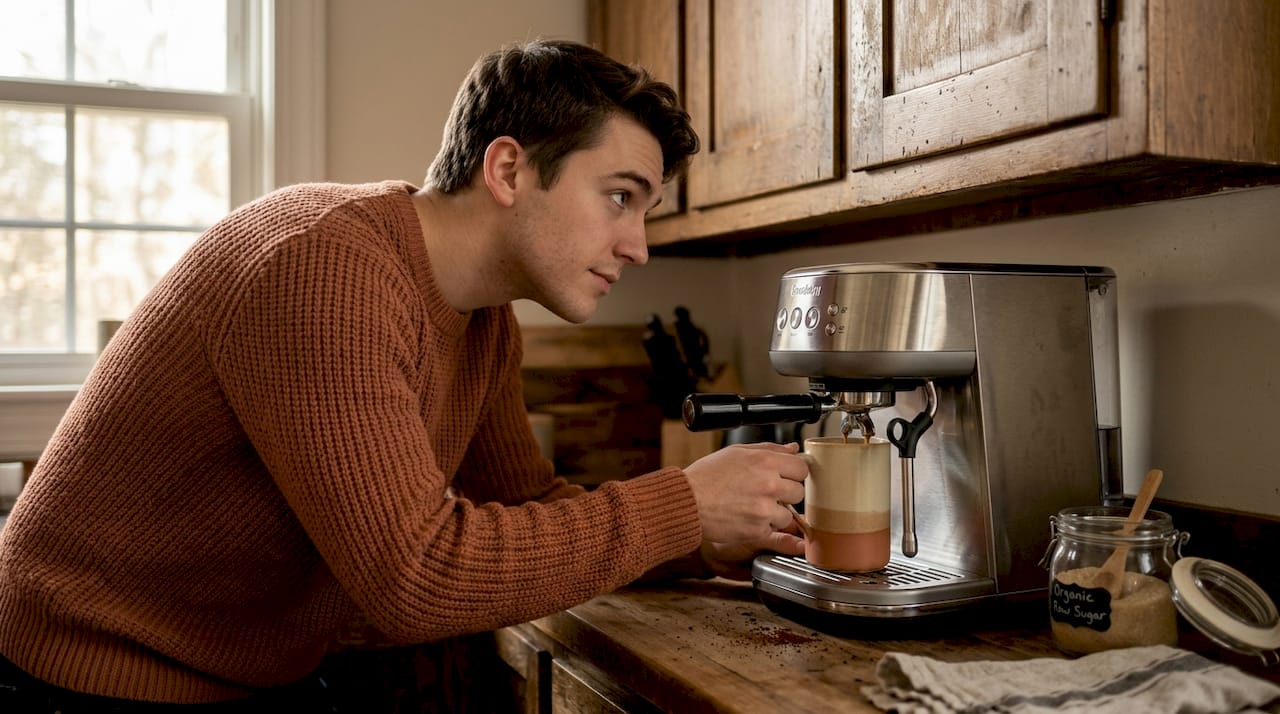
Typical espresso machine dimensions by category
Here's a quick reference for how espresso machine dimensions vary across common machine types:
| Machine type | Typical width | Typical depth | Typical height |
|---|---|---|---|
| Ultra-compact (e.g., Breville Bambino Plus) | 7 in | 12 in | 12 in |
| Mid-size all-in-one (e.g., Breville Barista Express) | 12.5 in | 13.8 in | 15.9 in |
| Prosumer semi-auto | 14 to 16 in | 16 to 18 in | 14 to 17 in |
| Commercial single-group | 18 to 22 in | 20 to 24 in | 20 to 24 in |
These figures represent chassis only. Every category requires additional planning space beyond what this table shows.
Ventilation and clearance: the invisible footprint
Here's something most buyers don't think about until it's too late. Your espresso machine generates significant heat during operation, and that heat needs somewhere to go. Manufacturers recommend leaving a minimum of 2 to 3 inches of open space on the sides, back, and top of the machine for heat dissipation and maintenance access. Ignoring this doesn't just shorten the machine's lifespan. It can create genuine safety concerns in enclosed spaces.
The risks of poor ventilation are real and specific:
- Overheating causes thermal cutoffs to trigger, interrupting your shot mid-pull.
- Reduced boiler efficiency forces the machine to work harder to maintain temperature, wearing out heating elements faster.
- Moisture buildup in tight spaces can damage cabinetry and create mold conditions behind the machine.
- Blocked maintenance access makes descaling and cleaning harder, which means it gets skipped more often.
Placement near overhead cabinets adds another layer of complexity. The Breville Barista Touch stands 16 inches tall but needs roughly 20 to 21 inches of vertical clearance for comfortable access to the bean hopper on top. Standard upper cabinets sit about 18 inches above the counter. That's a problem many buyers discover only after installation.
Pro Tip: Before placing your machine under a cabinet, measure from the counter surface to the bottom of the cabinet shelf, then subtract your machine's height. If the remaining gap is less than 4 inches, you'll struggle with refilling the hopper and cleaning the top of the machine.
How machine features expand the real footprint
The chassis is just the beginning. Several operational features push the effective espresso machine space requirements well beyond what the spec sheet suggests, and understanding each one helps you plan accurately.
Portafilter projection
This is the most underestimated factor in footprint planning. When a portafilter is locked into the group head, it extends forward from the machine's front face. The Fellow Espresso Series 1 measures 17.24 inches in total length, projecting approximately 21.5 inches from the back of the machine to the tip of the portafilter when in place. That's nearly 4 extra inches you need in front of the machine just to operate it normally.
Steam wand reach
The steam wand swings out to the side during milk frothing. Proper workflow requires 6 to 8 inches of clear space on the steam wand side to move a pitcher freely without hitting a wall, a grinder, or another appliance. Placing a machine flush against a wall on the wand side makes frothing awkward and slow.
Water tank and lid access
Rear-loading water tanks need clearance behind the machine for removal and refilling. Top-loading tanks require vertical clearance above. Neither situation is accounted for in published dimensions.
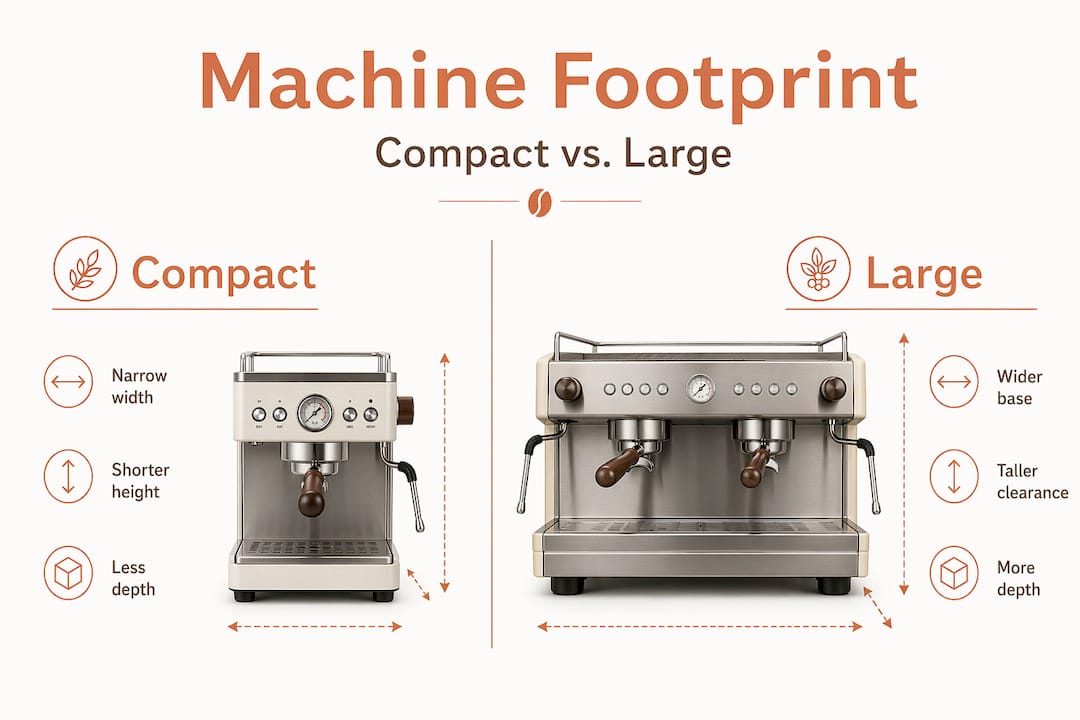
Comparing compact vs. larger machines
| Feature | Compact machine (e.g., Bambino Plus) | Larger machine (e.g., Barista Express) |
|---|---|---|
| Chassis footprint | Very small (~7" × 12") | Moderate (~12.5" × 13.8") |
| Portafilter clearance needed | Same as larger machines | Same as compact machines |
| Steam wand clearance | Required (6 to 8 in) | Required (6 to 8 in) |
| Hopper/tank access | Side or rear tank | Integrated hopper on top |
| Ideal for | Tight counters, low volume | Daily home use, integrated grinding |
The Breville Bambino Plus is one of the best small espresso machines available at roughly 7 inches wide, but it still demands the same steam wand clearance as machines twice its size. Compact doesn't mean low-maintenance in terms of space planning.
How to measure your space for an espresso machine
Knowing the concept is one thing. Applying it to your actual counter is where most people either get it right or end up rearranging their kitchen. Here's a practical process that works whether you're setting up a home bar or planning a café station.
- Measure your available counter width. Use a tape measure and note the exact distance between fixed obstacles like walls, cabinets, or appliances. Don't estimate.
- Subtract steam wand clearance. Identify which side the steam wand sits on for your target machine, then reserve 6 to 8 inches on that side for pitcher movement.
- Add portafilter depth to the machine's published depth. Check the manufacturer's spec sheet for total machine length with portafilter, or add approximately 3 to 4 inches to the listed depth as a conservative estimate.
- Check vertical clearance. Measure from counter to the bottom of any overhead cabinet. Compare that to the machine height plus 4 inches minimum for top access.
- Account for rear clearance. Leave 2 to 3 inches behind the machine for ventilation and water tank access.
- Mark it out physically. Use tape on the counter to outline the full footprint including all clearances before you commit to a purchase.
Pro Tip: Place a cardboard box the size of your target machine on the counter and live with it for a day. Open drawers, make coffee, move around the kitchen. You'll immediately feel whether the placement works before spending a dollar.
Common mistakes to avoid include placing the machine in a corner where the portafilter can't swing freely, positioning it under a low cabinet that blocks hopper access, and forgetting to account for the grinder sitting beside the machine. If you're running a combined espresso and grinder setup, the total footprint of both units together, plus workflow clearance between them, defines your real counter commitment.
Footprint and machine selection: matching size to your needs
Understanding espresso machine footprint doesn't just help you fit a machine onto your counter. It directly shapes which machine you should buy in the first place. Capacity and footprint are linked. Compact machines suit low-volume home use beautifully. Commercial-scale machines with larger boilers and bigger footprints exist because high-volume environments need them.
Here's how footprint considerations map to different user profiles:
- Small apartment or galley kitchen: Prioritize ultra-compact machines with rear-loading tanks and minimal top clearance needs. Accept trade-offs in boiler size and steam power.
- Dedicated home coffee station: A mid-size all-in-one machine with an integrated grinder makes sense. Plan for the combined footprint of machine plus accessories.
- Home café or frequent entertaining: A prosumer semi-auto with a separate grinder gives you performance, but requires a serious counter commitment of 24 to 36 inches of width.
- Small commercial or office setting: Larger machines with bigger boilers handle volume but demand professional-grade counter space and ventilation planning.
The right machine isn't always the one with the best specs. It's the one whose full footprint, including all clearances and operational space, fits your actual environment without compromising your workflow.
My take on footprint planning
I've watched a lot of people go through the same painful cycle. They research machines for weeks, focus entirely on extraction quality and features, buy something great, and then spend the first month frustrated because the steam wand keeps hitting the cabinet or they can't open the water tank without moving the machine. The footprint conversation almost never happens until after the machine arrives.
In my experience, the portafilter projection and the steam wand clearance are the two factors that surprise people most. You read "7 inches wide" and imagine a tidy little machine sitting quietly in a corner. What you get is a machine that needs 15 inches of operational width once the wand is out and the pitcher is in your hand. That's not a flaw in the machine. It's a flaw in how we read spec sheets.
What I've found actually works is treating footprint planning the same way you'd plan furniture placement. You wouldn't buy a couch without measuring the room. Measure the machine's full operational envelope, not just its body, and then measure your space. The cardboard box trick I mentioned earlier sounds silly, but it has saved more than a few people from buyer's remorse.
Ventilation is the other thing I'd push harder on. Machines tucked into tight alcoves or pushed against walls on three sides run hotter, trip thermal protection more often, and wear out faster. Two to three inches of clearance on each side is the minimum. More is always better. Treat it like a non-negotiable part of the setup, not an afterthought.
— Oleg
Find the right machine for your space
If you've made it this far, you're thinking about espresso machine footprint the right way: holistically, with real use in mind. The next step is finding machines that actually fit your space and your workflow without sacrificing the coffee quality you're after.
At Crema-lab, every review and buying guide is built around manufacturer-verified specifications with honest assessments of real-world space requirements. Whether you're hunting for the best compact option for a tight kitchen or planning a full home café setup, the espresso machine guides at Crema-lab break down dimensions, clearance needs, and workflow considerations in plain language. You get the information you need to buy confidently the first time, not after a frustrating return.
FAQ
What does espresso machine footprint mean?
Espresso machine footprint refers to the total counter space a machine occupies and requires during use, including the chassis dimensions, portafilter projection, steam wand clearance, and ventilation space around the unit.
How do I measure the footprint of an espresso machine?
Start with the manufacturer's published width and depth, then add 3 to 4 inches to the front for portafilter projection, 6 to 8 inches on the steam wand side, and 2 to 3 inches on remaining sides for ventilation clearance.
Do compact espresso machines still need clearance space?
Yes. Even the smallest machines, like the Breville Bambino Plus at roughly 7 inches wide, require the same steam wand and portafilter clearance as larger machines. The chassis is smaller, but the operational footprint is not proportionally reduced.
Why does vertical clearance matter for espresso machines?
Vertical clearance affects both ventilation and access to top-loading components. A machine like the Breville Barista Touch needs 20 to 21 inches of vertical space despite being 16 inches tall, because the bean hopper on top requires room to open and refill comfortably.
How much space should I leave behind an espresso machine?
Leave a minimum of 2 to 3 inches behind the machine for heat dissipation and water tank access. Machines placed flush against a wall trap heat, which reduces performance and shortens the lifespan of internal components.