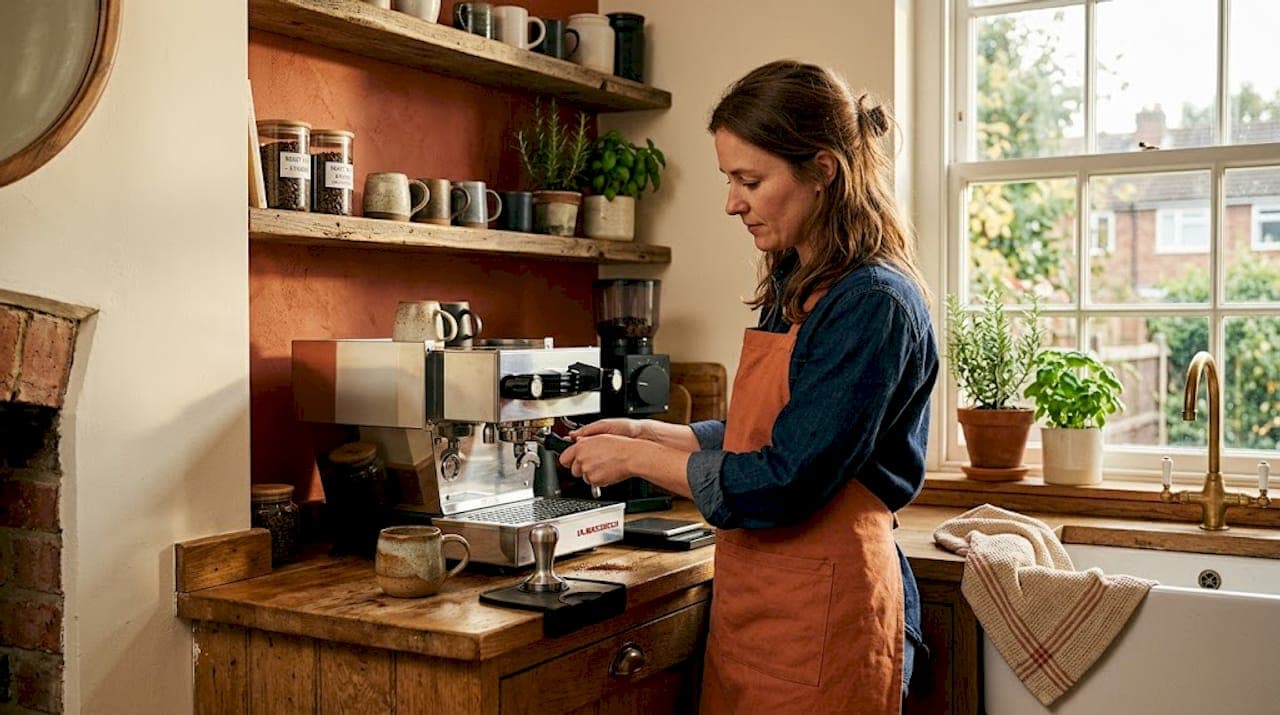
You fell in love with a machine online, ordered it, and then realized it doesn't fit under your cabinets. It happens more than you'd think. A proper espresso machine size comparison is the step most home enthusiasts skip, and it's the one they regret most. Width, depth, and height each tell a different story about how a machine will actually live on your counter. This guide walks you through the dimensions that matter, shows you how real machines stack up, and helps you match a machine to your specific kitchen and brewing routine.
Table of Contents
- Key takeaways
- 1. Espresso machine size comparison: the criteria that actually matter
- 2. Understanding machine types and their space demands
- 3. The Breville Bambino Plus: compact semi-auto benchmark
- 4. The Terra Kaffe TK Demi: when narrow isn't the whole story
- 5. Side-by-side espresso machine footprint comparison
- 6. How to choose espresso machine size based on your brewing habits
- 7. Common sizing mistakes to avoid
- My take on espresso machine sizing after years of recommendations
- Find your perfect fit with Crema-lab
- FAQ
Key takeaways
| Point | Details |
|---|---|
| Measure all three dimensions | Width, depth, and height each create different constraints; missing any one leads to poor fit. |
| Depth is the sneaky problem | Narrow machines often compensate with extra depth, which can conflict with backsplashes. |
| Workflow space matters as much as footprint | You need room to tamp, place cups, and steam milk beyond the machine itself. |
| Match machine type to daily habits | Pod machines save space but limit control; semi-autos need more room but reward skill. |
| Budget for a grinder in your layout | A quality grinder takes up additional counter space that most buyers forget to account for. |
1. Espresso machine size comparison: the criteria that actually matter
Most buyers look at a machine's width and stop there. That's a mistake. A full espresso machine size comparison requires you to think about three separate dimensions and how each one interacts with your specific counter setup.
Width determines how much horizontal counter real estate the machine claims. Most home machines range from 7 to 13 inches wide. Narrower is obviously better for tight spaces, but width alone doesn't tell the whole story.
Depth is where buyers get surprised. Compact machines often trade width for depth, which can push the machine uncomfortably close to your backsplash or make the water tank hard to reach. A machine that's 7.5 inches wide but 15.7 inches deep may actually consume more usable counter than a wider, shallower model.
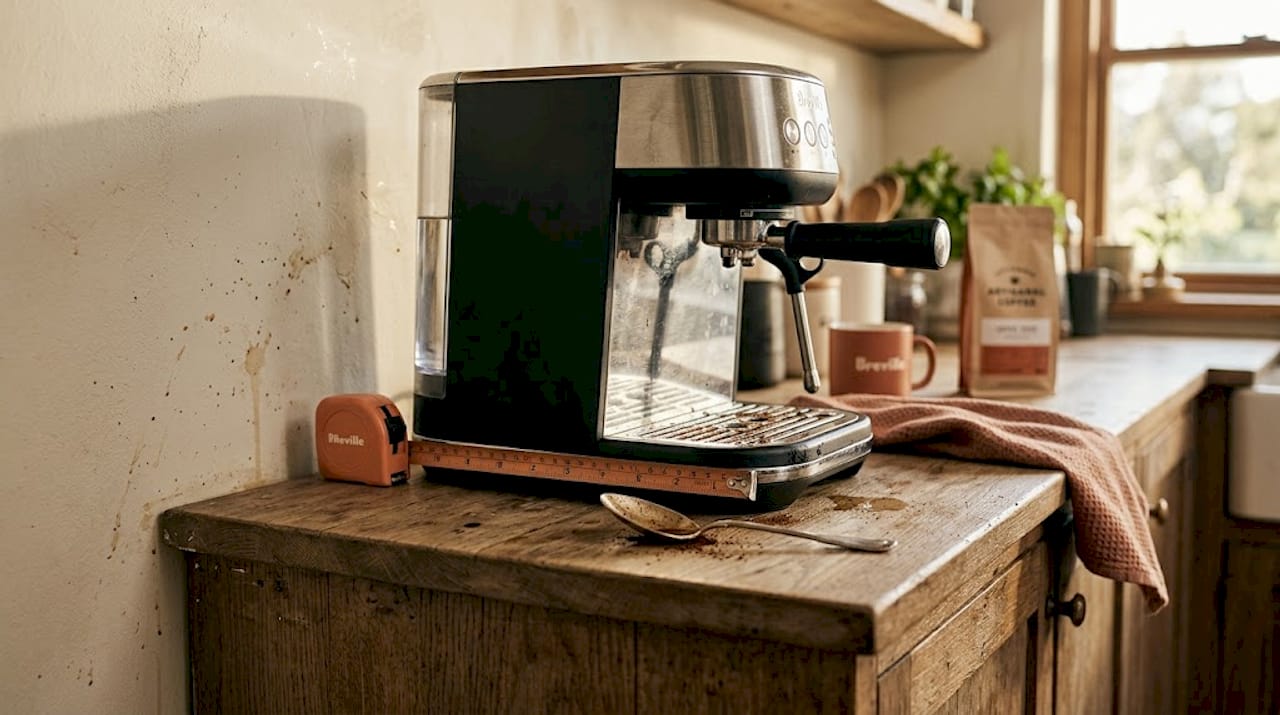
Height is the dimension that determines whether the machine fits under your upper cabinets at all. Overhead clearance matters not just for fitting the machine, but for filling the water tank and accessing the portafilter without awkward angles.
Beyond raw dimensions, think about workflow space. Workflow space is often overlooked in size assessment but it's where the actual work happens. You need room to set down a portafilter, place a cup, and position a milk pitcher. A machine that fits perfectly on paper can still feel cramped if you haven't accounted for the 8 to 12 inches of working room you need on either side.
Pro Tip: Before you shop, put a cardboard box with your target machine's dimensions on your counter for a full day. You'll immediately see whether the depth conflicts with your backsplash and whether the height clears your cabinets.
2. Understanding machine types and their space demands
Not all espresso machines make the same spatial demands, and the type you choose shapes your entire counter setup.
Semi-automatic machines like the Breville Bambino Plus require the most workflow space because you're actively tamping, pulling shots, and steaming milk as separate steps. The machine footprint is just the starting point. Semi-automatic machines require more workflow space than pod machines because each step in the process needs physical room.
Pod and capsule machines have a smaller station footprint in practice. You insert a capsule, press a button, and you're done. But pod machines don't allow puck compaction tuning, which matters if you care about dialing in your espresso. The tradeoff is real: less space, less control.
Fully automatic machines sit in the middle. They grind, tamp, and brew internally, which reduces the external workflow area you need. The machines themselves tend to be larger, but the total station footprint can actually be smaller than a semi-auto setup with a separate grinder.
3. The Breville Bambino Plus: compact semi-auto benchmark
If you're looking at space-saving espresso machines in the semi-automatic category, the Bambino Plus is the reference point. Its dimensions are 7.7" wide, 12.6" deep, and 12.2" tall, which puts it among the most compact traditional footprints in its class.
What makes the Bambino Plus work for small kitchens isn't just the width. The 12.2-inch height clears most standard upper cabinets with room to spare. The 12.6-inch depth is manageable for most counters, leaving enough room between the machine and the backsplash to fill the water tank comfortably.
Key size-related pros and cons:
- Pro: One of the narrowest semi-auto machines at 7.7 inches wide
- Pro: Height clears standard 18-inch cabinet clearance easily
- Con: Still requires a separate grinder, adding 6 to 8 inches of additional counter width
- Con: Workflow space for tamping and steaming adds to the practical footprint
Breville markets it as a "compact footprint" machine suitable for most countertops, and that claim holds up when you compare it against the broader semi-auto category.
4. The Terra Kaffe TK Demi: when narrow isn't the whole story
The TK Demi is a fully automatic machine that illustrates the width-versus-depth tradeoff perfectly. At 7.5 inches wide and 15.7 inches deep, it's actually narrower than the Bambino Plus but significantly deeper.
That extra depth is the catch. On a standard 24-inch deep counter, a 15.7-inch machine leaves only about 8 inches between the front of the machine and the counter edge. That's enough to place a cup, but it's tight. If your counter is shallower or if you have a window above the sink nearby, that depth becomes a real constraint.
The upside is that the TK Demi handles grinding and brewing internally, so you don't need a separate grinder on the counter. The total station footprint can actually be competitive with the Bambino Plus setup once you factor in grinder space.
Key size-related pros and cons:
- Pro: Narrowest width at 7.5 inches, fits in very tight horizontal spaces
- Pro: Built-in grinder eliminates need for a separate countertop unit
- Con: 15.7-inch depth is the deepest in this comparison, challenging for shallow counters
- Con: Height at 12.8 inches is slightly taller than the Bambino Plus
5. Side-by-side espresso machine footprint comparison
Here's where the espresso machine size comparison gets concrete. This table reflects manufacturer-verified dimensions for the two featured machines, with practical notes on how each dimension affects real kitchen use.
| Spec | Breville Bambino Plus | Terra Kaffe TK Demi |
|---|---|---|
| Width | 7.7" | 7.5" |
| Depth | 12.6" | 15.7" |
| Height | 12.2" | 12.8" |
| Built-in grinder | No | Yes |
| Workflow type | Semi-automatic | Fully automatic |
| Grinder needed | Yes (adds 6–8" width) | No |
| Best counter type | Shallow, wide counters | Deep counters with limited width |
The table shows something that raw footprint numbers miss. The TK Demi is technically narrower, but the Bambino Plus wins on depth by a significant margin. If your counter is deep but narrow, the TK Demi makes sense. If your counter is wide but shallow, the Bambino Plus is the better fit.
Pro Tip: When using this comparison, measure your counter depth from the wall to the front edge, then subtract your target machine's depth. The remaining space is what you have for cup placement and daily workflow. Anything under 7 inches gets uncomfortable fast.
6. How to choose espresso machine size based on your brewing habits
Raw dimensions only get you so far. The right size also depends on how you actually use your machine every morning.
If you make one or two black espressos per day, a compact semi-auto like the Bambino Plus gives you the smallest footprint with full control over your shot. You'll need a grinder, but a compact burr grinder like the Baratza Encore ESP adds only about 6 inches of width.
If you make multiple milk drinks daily, dual boiler machines are better for steaming multiple drinks simultaneously but come with a larger footprint. In this case, prioritize counter depth over width, since dual boiler machines tend to be wider but not dramatically deeper.
If convenience matters more than control, a fully automatic machine like the TK Demi reduces your workflow footprint even if the machine itself is deeper. You trade customization for simplicity and a cleaner counter setup.
One factor most buyers forget: budget 30 to 40 percent of your espresso setup cost for grinder quality. That grinder takes up physical space too. A $400 machine paired with a $200 grinder means two devices on your counter. A $600 fully automatic machine means one.
Pro Tip: If you're tight on counter width, place your grinder on a small shelf or rolling cart beside the counter rather than on it. This keeps your espresso station clean and gives you back 6 to 8 inches of working space.
7. Common sizing mistakes to avoid
Even experienced buyers make these errors when comparing espresso machines by size.
Ignoring overhead clearance. A machine that fits the counter footprint perfectly can still be unusable if your upper cabinets are 14 inches above the counter and your machine is 13 inches tall. You won't be able to open the water tank lid or access the portafilter without sliding the machine out every time.
Treating width as the only metric. A machine that's 2 inches narrower but 4 inches deeper than an alternative isn't actually saving you space. It's shifting the constraint. Evaluate total footprint as width multiplied by depth, then layer in height separately.
Forgetting the cup clearance gap. Most espresso machines have a fixed distance between the group head and the drip tray. If that gap is only 2.5 inches, you can't fit a standard 3-inch tall cappuccino cup without removing the drip tray every time. This isn't a size issue in the traditional sense, but it affects daily usability just as much.
Underestimating the grinder. If you're buying a semi-auto machine, your counter plan isn't complete without placing a grinder next to it. A Niche Zero, for example, is about 6 inches wide and 14 inches tall. That changes your cabinet clearance math entirely.
My take on espresso machine sizing after years of recommendations
I've spent years looking at how people actually set up their home espresso stations, and the pattern I see most often is this: buyers obsess over the machine's width and completely ignore depth and overhead clearance. They end up with a machine that technically fits but is annoying to use every single day.
The insight that changed how I make recommendations is that matching daily habits to workflow-friendly size matters more than chasing the smallest footprint. I've seen people buy ultra-compact machines and then hate them because the workflow is cramped. I've also seen people buy larger machines and love them because the extra width gave them room to actually work.
My honest advice: don't buy the smallest machine that fits. Buy the smallest machine that fits comfortably. There's a real difference. The cardboard box trick I mentioned earlier is something I recommend to everyone. It sounds silly, but it forces you to confront the depth and workflow reality before you're stuck with a return label.
The grinder point also gets underestimated in almost every buying conversation I have. You can't evaluate your espresso station footprint without including the grinder. Plan for both from the start, and your setup will feel intentional rather than improvised.
— Oleg
Find your perfect fit with Crema-lab
At Crema-lab, we publish honest, manufacturer-verified espresso machine buying guides built specifically for home enthusiasts who care about both brew quality and kitchen space. Our size-focused reviews include exact dimensions, workflow space notes, and side-by-side comparisons so you're never surprised by a machine that doesn't fit. Whether you're looking at compact semi-autos or fully automatic options, our guides walk you through the real-world tradeoffs before you spend a dollar. Visit Crema-lab to find a machine that fits your counter, your routine, and your standards.
FAQ
What dimensions should I measure before buying an espresso machine?
Measure your counter width, depth from wall to edge, and the clearance between the counter surface and your upper cabinets. All three determine whether a machine fits and stays usable.
Is the Breville Bambino Plus really compact enough for small kitchens?
At 7.7" wide, 12.6" deep, and 12.2" tall, it's one of the most space-efficient semi-automatic machines available and fits comfortably on most standard counters.
Why does depth matter more than width in an espresso machine size comparison?
Depth determines how much working space remains between the machine and the counter edge. A machine that's narrow but very deep can leave you with less usable room than a wider, shallower alternative.
Do I need to account for a grinder when planning counter space?
Yes. If you buy a semi-automatic machine, a separate burr grinder adds 6 to 8 inches of width and up to 14 inches of height to your station setup.
Are pod machines actually smaller than traditional espresso machines?
Pod machines tend to have a smaller station footprint in practice because they require no grinder and minimal workflow space, though they sacrifice shot customization in exchange.